travelgiftly.com

Tech & Gadget Comparisons

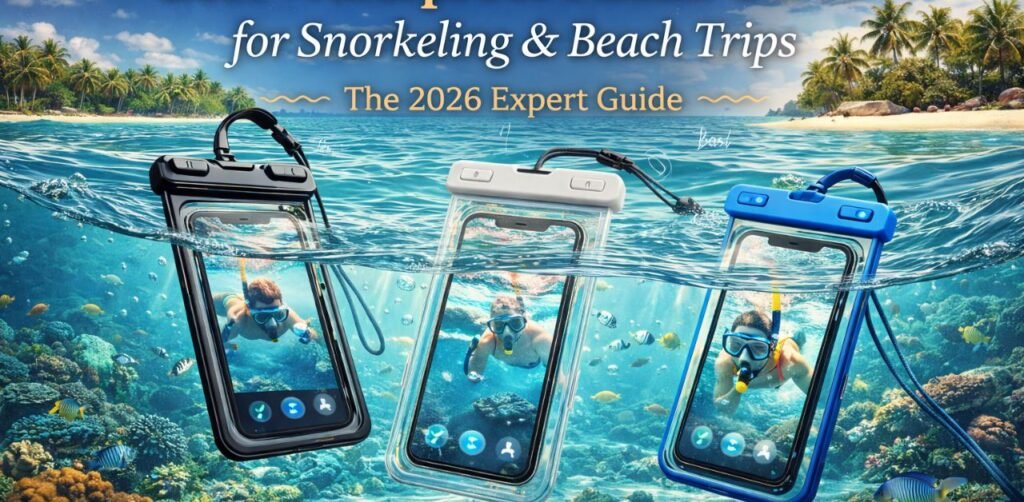
Best Waterproof Phone Cases for Snorkeling & Beach Trips: The 2026 Expert Guide
Tech & Gadget Comparisons

Best Waterproof Phone Cases for Snorkeling & Beach Trips: The 2026 Expert Guide

In 2026, smartphone cameras have reached a point where they can rival professional photography gear. However, the ocean remains the ultimate enemy of electronics. Whether you are swimming in the crystal-clear waters of the Maldives or snorkeling through the Great Barrier Reef, the right protection is non-negotiable. Instead of hunting for specific brands that might go out of stock, the modern traveler should look for categories of protection. Understanding the difference between a simple beach pouch and a professional-grade housing is the key to keeping your device safe and your photos sharp. Comparison: Types of Waterproof Protection Technology Type Best Use Case Max Depth Photo Clarity Air-Padded Pouches Casual swimming & boating 100ft (IPX8) Good Vacuum-Sealed Cases Active snorkeling & video 50ft Excellent Hard-Body Dive Shells Deep diving & free diving 130ft Professional Slim Integrated Cases Surfing & coastal hiking 20ft Very Good 1. The Universal Floating Pouch: Best for General Beach Travel The most common type of protection is the universal soft pouch. In 2026, the best versions of these come with “active buoyancy.” These are transparent bags with a specialized air-filled border. 2. Vacuum-Sealed Professional Housings: The Choice for Snorkelers Standard pouches often struggle underwater because the air trapped inside pushes against the plastic, making the touchscreen hard to use. The 2026 solution is the Vacuum-Sealed Housing. 3. Hard-Shell Dive Cases: For the Deep Explorers If your snorkeling turns into free diving (descending more than 10 feet), a soft pouch isn’t enough. You need a hard-shell case. Key Technical Features to Check in 2026 When browsing for your next trip, ignore the marketing fluff and look for these three technical specs: Internal Linking & Travel Synergy Planning a snorkeling trip involves more than just a case. If you are traveling to a foreign country to find those secret reefs, you’ll need to communicate with local boat captains. A pocket-sized AI translator is a perfect companion to help you negotiate prices and find the best hidden spots. Additionally, for those quiet moments on the boat ride back, don’t forget to pack your Sony or Bose noise-canceling headphones to block out the engine noise and relax with some music. Maintenance Tips for Longevity Frequently Asked Questions (FAQs) Q: Can I use my phone’s fingerprint sensor or FaceID through these cases? A: FaceID usually works through high-clarity pouches, but fingerprint sensors (TouchID) generally do not work through the plastic. We recommend setting your phone to “Never Sleep” or using a passcode before you head into the water. Q: Will salt water damage the case over time? A: High-quality TPU and Polycarbonate are resistant to salt, but the metal hinges or clips can rust if not rinsed with fresh water after every use. Q: Is it safe to take these into a swimming pool? A: Yes, but be aware that chlorine can be just as harsh as salt. Always rinse the case after a pool session to prevent the plastic from turning yellow or becoming brittle. Conclusion Capturing the beauty of the ocean is one of the most rewarding parts of modern travel. By choosing a case based on its IPX8 rating, seal technology, and buoyancy, you are doing more than just buying a gadget—you are protecting your memories. Whether you opt for a simple floating pouch or a professional vacuum-sealed housing, ensure it fits your specific style of adventure.
Pocket-Sized AI Translators for World Travelers: Breaking Language Barriers in 2026
Tech & Gadget Comparisons

Pocket-Sized AI Translators for World Travelers: Breaking Language Barriers in 2026

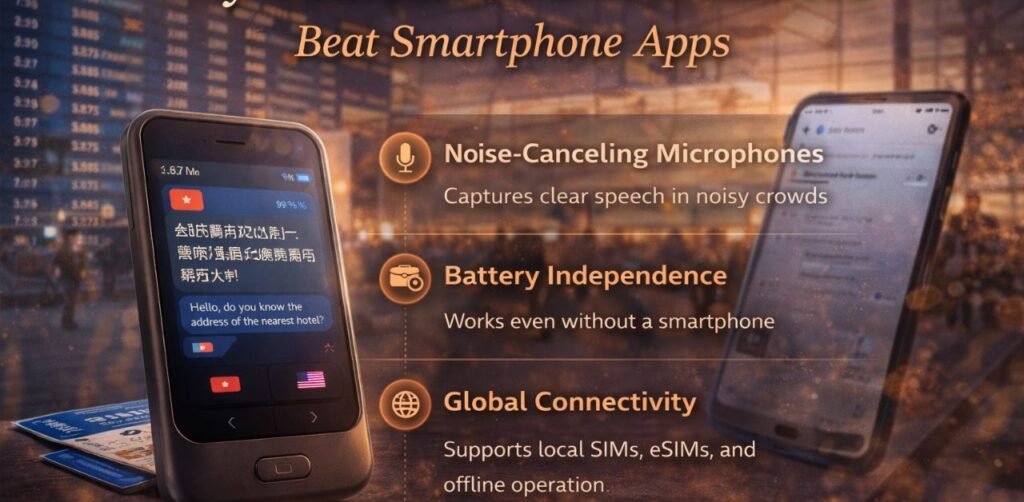
Imagine standing in a bustling night market in Seoul, or a remote mountain village in Peru, and being able to hold a fluid, deep conversation with a local without knowing a word of their language. Just a few years ago, this was the stuff of science fiction. Today, it is a reality in the palm of your hand. For world travelers, communication is the gateway to authentic experiences. While smartphone apps are useful, they often fail in noisy environments, drain your phone battery, and require a constant internet connection. This is why pocket-sized AI translators have become an essential part of the modern international flight gear kit. In this 2026 guide, we explore the best dedicated translation devices that are transforming how we explore the globe. Comparison: Top AI Translators for 2026 Model Languages Connection Best For Key Feature Vasco Translator V4 108+ Free Lifetime Data Ultimate Globetrotters Large 5″ Screen Timekettle T1 Mini 40+ 1-Year Free Data Minimalist Travelers One-Click Translation Pocketalk S 82+ Built-in eSIM Foodies & Explorers Camera (Text) Translation Langogo Genesis 100+ Wi-Fi / eSIM Business Travelers AI Voice Assistant Timekettle WT2 Edge 40+ Bluetooth / App Long Conversations Translation Earbuds Why Dedicated AI Translators Beat Smartphone Apps Many travelers ask: “Why not just use my phone?” While apps have improved, dedicated hardware offers three distinct advantages: Top Picks: Detailed Reviews for 2026 1. Vasco Translator V4: The Connectivity King The Vasco V4 is the gold standard for 2026. Its standout feature is the lifetime free internet for translation. It is rugged, shock-resistant, and dust-proof, making it the perfect companion for those who love lightweight gear for minimalist backpackers. 2. Timekettle T1 Mini: The Budget Powerhouse If you want something that fits in your coin pocket, the T1 Mini is the answer. It’s about the size of a credit card and focuses on “One-Button” ease of use. It’s an excellent gift for those looking for inexpensive retirement gifts for world travelers who might prefer simplicity over complex tech. 3. Pocketalk S: The Visual Explorer Visual translation is where the Pocketalk S shines. See a sign, a menu, or a handwritten note? Just snap a photo. It translates the text instantly on-screen, which is a lifesaver when navigating public transit in countries with non-Latin scripts. Essential Maintenance: Keeping Your Translator Trail-Ready To ensure your device remains reliable during your travels, follow these “trail-ready” maintenance steps: What to Look for When Buying in 2026 When shopping for pocket-sized AI translators, keep these three factors in mind: Frequently Asked Questions (FAQs) 1. Do I have to pay a monthly subscription for these devices? Most high-end devices like Vasco include lifetime data. Others, like Timekettle or Pocketalk, may offer the first 1-2 years free, after which you can top up the data or use Wi-Fi. 2. How accurate is AI translation in 2026? For common languages, accuracy is now between 95% and 98%. It can even handle regional dialects and slang quite well, though technical medical or legal terms still require caution. 3. Can I use these for learning a language? Yes! Most devices include a “history” feature that allows you to replay translated phrases, making them excellent tools for active learning while on the go. 4. Are these devices waterproof? While many are splash-resistant, very few are fully waterproof. We recommend keeping them in a small water-resistant tech pouch when traveling in tropical or rainy climates. Conclusion Pocket-sized AI translators for world travelers are no longer just a “nice-to-have” gadget; they are a bridge to deeper cultural connection. By taking the technical weight off your smartphone and providing specialized audio and connectivity features, these devices allow you to travel with a new sense of confidence. Whether you choose the lifetime connectivity of the Vasco V4 or the pocket-sized simplicity of the Timekettle T1 Mini, you are investing in a smoother, richer travel experience. Safe travels, and may you never be lost for words again!

High-Speed GaN Chargers: The Ultimate Power Solution for Digital Nomads (2026)
Tech & Gadget Comparisons

High-Speed GaN Chargers: The Ultimate Power Solution for Digital Nomads (2026)

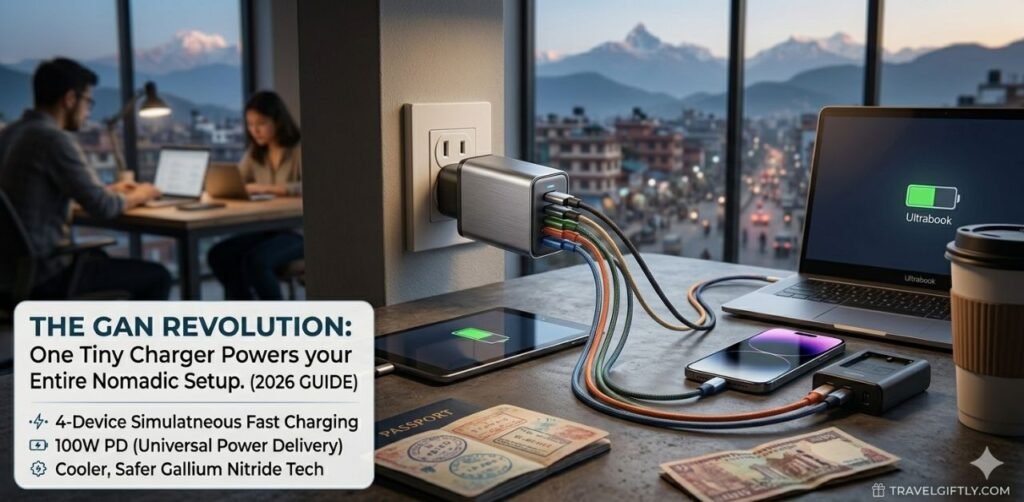
For a digital nomad, power is the ultimate currency. Whether you are working from a beachfront café in Bali or a high-altitude co-working space in Medellín, your productivity depends entirely on how quickly and reliably you can charge your gear. The days of carrying massive, heavy power bricks for your laptop, tablet, and smartphone are over. Enter GaN (Gallium Nitride) technology—the revolution that has made chargers smaller, faster, and more efficient than ever before. In this guide, we explore why GaN is the gold standard for travel and which chargers you should pack for your next adventure. Why GaN Chargers are a Game-Changer for Travel Traditional chargers use silicon, which generates significant heat and requires bulky components to stay cool. GaN chargers, however, use Gallium Nitride, a material that conducts electrons 1000 times more efficiently than silicon. The Benefits for Nomads: Comparison: Top 5 GaN Chargers for Nomads 2026 Model Max Output Ports Best For Travel Plug Style Anker Prime 100W 100W 2x USB-C, 1x USB-A The All-Rounder Foldable US (International Adapters) Satechi 165W USB-C 165W 4x USB-C Heavy Video Editors Detachable Power Cord Ugreen Nexode Pro 65W 65W 2x USB-C, 1x USB-A Minimalist Backpackers Ultra-Slim Foldable Shargeek Retro 67 67W 3x USB-C Style & Data Tracking Foldable US Baseus Blade 2 65W 65W 2x USB-C Ultra-Thin (Laptop Bag) Flat Profile Top Picks: Detailed Reviews 1. Anker Prime 100W GaN Charger Anker remains the king of reliability. The Prime 100W is exceptionally dense and can fast-charge a 16-inch MacBook Pro to 50% in just 30 minutes. Its ActiveShield 2.0 technology monitors temperature millions of times a day to protect your expensive gadgets. 2. Ugreen Nexode Pro 65W If you are a minimalist traveler who only carries a 13-inch laptop and a phone, the Nexode Pro 65W is essentially the size of a box of matches. It is the perfect companion for our lightweight travel gifts for minimalist backpackers list. It fits into the smallest pocket of your daypack without adding any noticeable weight. 3. Satechi 165W USB-C 4-Port GaN Charger For digital nomads who are also content creators, the Satechi 165W is a beast. It can distribute power across four USB-C ports, allowing you to charge a laptop, a camera, a drone, and a power bank simultaneously. It uses a detachable power cord, which is actually a benefit for travel as you can simply swap the “figure-8” cable for one with a local plug. Essential Maintenance: Keeping Your Tech Trail-Ready Even the best GaN charger needs proper care to survive the rigors of nomadic life. Dust from dusty cafes or humidity from tropical climates can affect performance. How to Choose the Right Wattage Don’t just buy the highest wattage available. Match the charger to your most power-hungry device: Frequently Asked Questions (FAQs) 1. Is GaN technology safe for older devices? Yes. Modern GaN chargers use “Smart Power Allocation” to communicate with your device. They will only provide the amount of power the device can safely handle. 2. Can GaN chargers fit in airplane outlets? Because GaN chargers are so compact and heavy, they can sometimes fall out of loose airplane outlets. We recommend using a small “travel plug adapter” even if the pins match, as the extra friction helps keep the heavy block in place. 3. Do I need special cables for high-speed charging? Absolutely. To get 100W of power, you must use a USB-C cable with an E-Marker chip rated for 100W or 240W. Standard cables will often cap your speed at 60W. 4. Why is my GaN charger getting warm? While GaN is efficient, it still generates heat. It is normal for it to feel warm during a fast-charge cycle. However, if it is too hot to touch, unplug it immediately. Conclusion In 2026, there is no reason for a digital nomad to carry more than one charging brick. A high-speed GaN charger is a vital investment that reduces the weight of your bag while increasing your efficiency. Whether you choose the raw power of the Satechi 165W or the pocketable Ugreen 65W, you are choosing a future of “one-plug-fits-all.” Invest in a quality GaN charger today and spend less time tethered to a wall and more time exploring the world.

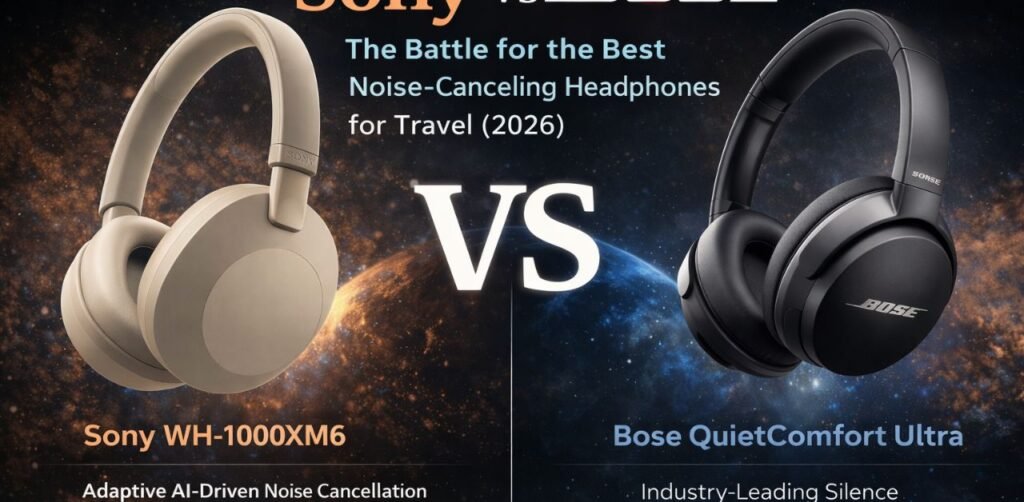
Sony vs. Bose: The Battle for the Best Noise-Canceling Headphones for Travel (2026)
Tech & Gadget Comparisons

Sony vs. Bose: The Battle for the Best Noise-Canceling Headphones for Travel (2026)

For the modern traveler, silence isn’t just a luxury—it’s a survival tool. Whether you are navigating a bustling terminal at Heathrow or trying to find a moment of peace on a 14-hour transpacific flight, the right pair of headphones can be the difference between a restful journey and a grueling ordeal. As we move into 2026, the rivalry between two tech giants has reached a fever pitch. On one side, we have Sony, the reigning champion of technical customization and smart features. On the other, Bose, the brand that practically invented Active Noise Cancellation (ANC) and continues to lead in pure, unadulterated comfort. In this guide, we break down the Sony vs. Bose showdown to help you decide which pair deserves a spot in your carry-on this year. Quick Comparison: Sony vs. Bose (2026 Flagship Models) Feature Sony WH-1000XM6 Bose QuietComfort Ultra Noise Cancellation Adaptive AI-Driven Industry-Leading Silence Battery Life 45 Hours (ANC On) 26 Hours (ANC On) Weight 248g 252g Spatial Audio 360 Reality Audio Immersive Audio Mode Connectivity Bluetooth 5.4 / Auracast Bluetooth 5.4 / Snapdragon Sound Foldability Hinged / Fully Foldable Hinged / Fully Foldable The Sony WH-1000XM6: The Smart Traveler’s Powerhouse Sony’s 2026 flagship, the WH-1000XM6, is a masterpiece of engineering. While previous models focused on raw power, the M6 is all about intelligence. Its new AI-Q Processor analyzes your environment 800 times per second, adjusting the noise cancellation profile not just for the roar of an engine, but for the specific frequency of a crying infant or the hiss of a cabin pressure valve. The Bose QuietComfort Ultra: The King of Comfort Bose has doubled down on its namesake: Comfort. The QuietComfort (QC) Ultra remains the most wearable pair of headphones on the market for 2026. The “CustomTune” technology calibrates the audio and the noise cancellation to the unique shape of your inner ear every time you put them on. Crucial Factors for Travelers When choosing between Sony vs. Bose, consider these three pillars of travel gear performance: 1. Portability and Build Quality In 2026, both brands have returned to fully foldable designs. This is a massive win for minimalist travelers. Sony uses high-grade recycled plastics that feel premium but lightweight, while Bose incorporates more aluminum in the hinges for a slightly more “luxury” feel. If you are a fan of lightweight travel gifts for minimalist backpackers, the Sony M6 wins by a few grams. 2. Transparency Mode Sometimes you need to hear the world—like when a flight attendant is asking for your meal preference or an announcement is made about a gate change. Sony’s “Ambient Sound” mode feels slightly more natural, sounding less like a digital recording and more like your own ears. 3. Call Quality Travelers often have to take work calls from noisy airport lounges. Bose’s microphone array is specifically tuned to isolate your voice from background chatter, making it the superior choice for digital nomads and business travelers. Pro-Tips for Headphone Maintenance on the Road Frequently Asked Questions (FAQs) 1. Can I use these headphones for in-flight entertainment? Yes, both Sony and Bose include a 3.5mm audio cable in the box. However, for a truly wireless experience in 2026, many travelers use a Bluetooth transmitter to connect their headphones to the plane’s seatback screen. 2. Is Sony’s noise cancellation better than Bose’s? It depends on the environment. Sony is better at blocking out high-frequency “unpredictable” sounds (like voices), while Bose remains the undisputed leader at blocking out low-frequency “droning” sounds (like jet engines). 3. Are these headphones waterproof? No. While they can handle a bit of humidity, neither the Sony WH-1000XM6 nor the Bose QC Ultra are waterproof. If you need something for the beach, look for IP-rated earbuds instead. 4. How long do the ear cushions last? With frequent travel, ear cushions typically last 18 to 24 months. Both brands allow for easy cushion replacement, which is a sustainable way to extend the life of your investment without buying a new pair. Conclusion: Which One Should You Pack? Choosing between the Sony WH-1000XM6 and the Bose QuietComfort Ultra in 2026 comes down to your personal travel philosophy. If you are a tech enthusiast who wants the best battery life, the most “intelligent” features, and a highly customizable EQ, the Sony WH-1000XM6 is your winner. It is a high-performance machine that adapts to you. However, if your primary goal is to disappear into a world of silence with the most comfortable fit possible for a 12-hour flight, the Bose QuietComfort Ultra is the gold standard. Regardless of your choice, both represent the pinnacle of 2026 travel technology. Investing in one of these means investing in your own well-being and peace of mind. Safe travels, and enjoy the silence!

The Ultimate Guide: Top-Rated Portable Espresso Makers for Campers (2026)
Tech & Gadget Comparisons

The Ultimate Guide: Top-Rated Portable Espresso Makers for Campers (2026)

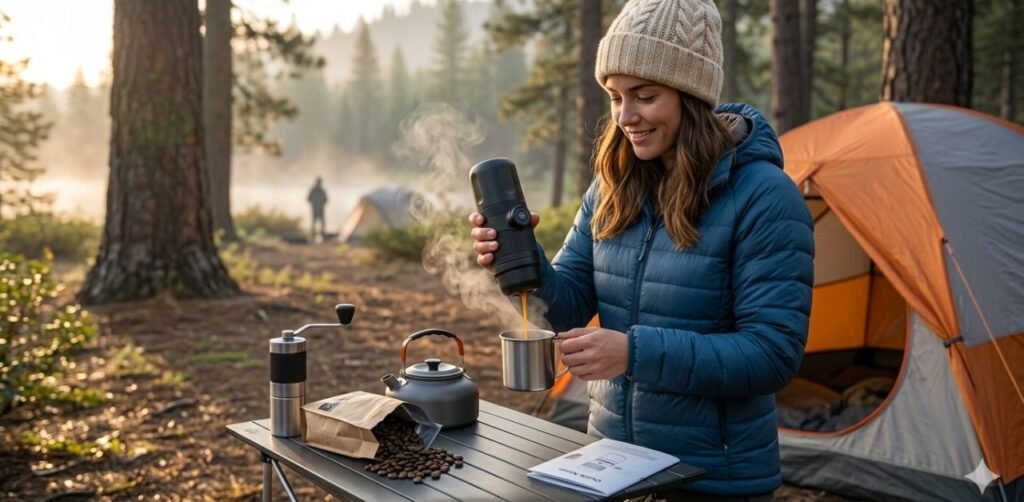
There is an old camping proverb: “The best cup of coffee you’ll ever have is the one brewed in the woods.” While instant coffee and campfire percolators have served travelers for decades, the 2026 camper demands something more refined. We are no longer satisfied with bitter, watery caffeine—we want the crema, the intensity, and the ritual of a true espresso, even when the nearest café is a three-hour hike away. The evolution of outdoor gear has brought us to a golden age of portable brewing. Today’s top-rated portable espresso makers for campers are lightweight, incredibly durable, and capable of producing up to 20 bars of pressure—rivaling high-end home machines. Whether you are a car camper who enjoys luxury or a minimalist hiker counting every gram, there is a brewer designed to fit your rhythm. In this comprehensive 2026 guide, we dive into the mechanics, the performance, and the practicality of the year’s best portable espresso machines. Quick Comparison: Top 10 Portable Espresso Makers Model Type Max Pressure Weight Best For Outin Nano Electric (Battery) 20 Bars 700g Self-Heating Convenience Wacaco Picopresso Manual 18 Bars 350g Professional Baristas Flair Go Manual Lever 15 Bars 1.2kg Precision Extraction Wacaco Nanopresso Manual 18 Bars 336g Versatile Travelers Staresso Pro Manual 20 Bars 500g Budget-Friendly Crema Handpresso E-Presso Electric 19 Bars 780g Luxury Car Camping Leverpresso Pro Manual Lever 12 Bars 440g Rugged Durability Cafflano Kompresso Hydraulic 9 Bars 200g Ultralight Backpackers Wacaco Minipresso GR2 Manual 18 Bars 290g Short Day Hikes AeroPress Premium Immersion/Press 2 Bars 300g Easy Cleanup Detailed Reviews of the 2026 Champions 1. Outin Nano: The Self-Heating Revolution The Outin Nano has redefined what “portable” means. While most manual machines require you to boil water separately, the Outin Nano features a high-capacity internal battery that heats 50ml of cold water to the perfect 198°F (92°C) in just 3 minutes. Its 20-bar pump ensures a silky smooth crema every time. Because it doesn’t require a stove, it has also become a staple in many a long-haul flight survival kit gifts for those who refuse to drink airline coffee. 2. Wacaco Picopresso: The Purist’s Dream If you are someone who enjoys the “dial-in” process of grinding and tamping, the Picopresso is your best companion. It features a 52mm naked portafilter that lets you watch the espresso extract. This level of control makes it a frequent entry in our Top 20 Luxury Travel Gifts for Men Who Have Everything because it provides a true café experience in the middle of a forest. 3. Wacaco Nanopresso: The All-Rounder The Nanopresso remains a fan favorite because of its adaptability. You can use ground coffee by default, but with a small adapter, it becomes compatible with Nespresso pods. Its compact, cylindrical shape makes it easy to tuck into a backpack side pocket. For those looking for lightweight travel gifts for minimalist backpackers, the Nanopresso offers the best balance of weight and performance. 4. Flair Go: The Lever Mastery The Flair Go is the 2026 version of the iconic manual lever machine. It is designed for the camper who has a bit more space (like a van or car camper) and wants to experiment with pressure profiling. It is built from high-grade aluminum and steel, meaning it will likely outlast all your other camping gear. 5. Cafflano Kompresso: The Ultralight Hydraulic Using hydraulic compression rather than a traditional pump, the Kompresso is one of the lightest “true” espresso makers available. At just 200g, it is barely noticeable in a pack. It is the perfect example of how space-saving packing hacks for carry-on travelers apply even to our outdoor hobbies. What to Consider Before Buying When choosing between the top-rated portable espresso makers for campers, you must evaluate your specific camping style. A car camper has different needs than a mountain climber. Maintenance: Keeping Your Gear Trail-Ready Cleaning an espresso maker at a campsite can be tricky without a kitchen sink. Frequently Asked Questions (FAQs) 1. Do portable espresso makers work with cold water? Only battery-powered electric models like the Outin Nano or Handpresso can heat cold water. Manual models require you to add pre-boiled water from a kettle or stove. 2. Is the crema as good as a home machine? Surprisingly, yes! Machines like the Picopresso and Nanopresso use pressurized systems that create professional-grade crema, provided you use a fine enough grind. 3. Are these machines safe for international flights? Yes. Manual machines have no restrictions. Battery-powered models use lithium-ion batteries, so they must be kept in your carry-on luggage rather than checked in, according to standard aviation safety rules. 4. Can I use regular grocery store coffee? For the best results, you should use an “espresso grind” (very fine). Regular drip coffee grounds are often too coarse and will result in a weak, watery shot. Conclusion: Elevate Your Morning View In 2026, the boundary between “roughing it” and “living well” has blurred. Choosing one of the top-rated portable espresso makers for campers ensures that your morning doesn’t start with a struggle, but with a celebration of flavor. Whether you are watching the mist rise over a lake or packing up your tent for a long day of hiking, having a barista-quality shot in your hand changes the entire energy of your trip. Invest in a tool that matches your adventure. Whether it’s a rugged lever press or a high-tech electric heater, your future self—standing in the cold morning air—will thank you for it.

10 Best Smart Luggage Trackers for International Flights (2026 Edition)
Tech & Gadget Comparisons

10 Best Smart Luggage Trackers for International Flights (2026 Edition)

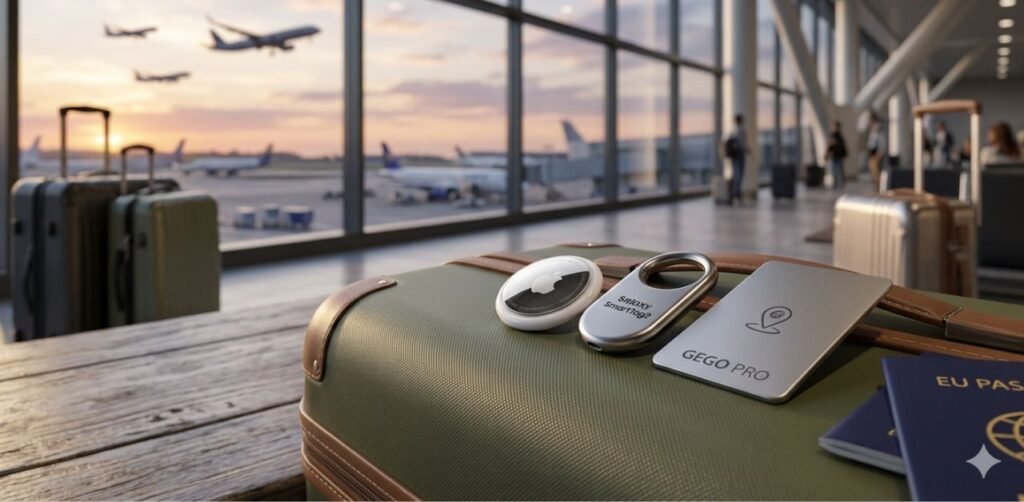
There is a specific kind of “carousel anxiety” every international traveler knows—standing at the baggage claim after a 12-hour journey, watching every suitcase pass by except yours. In 2026, with global air traffic at an all-time high, the risk of a “ghost tag” or a misrouted bag remains a frustrating reality. A smart luggage tracker is no longer a luxury; it is a fundamental part of a stress-free journey. Whether you are navigating a tight 45-minute layover in Dubai or embarking on a multi-city European tour, these devices give you the power to tell the airline exactly where your bag is—even when their systems fail. In the modern age of travel, information is the best insurance policy you can buy. The Evolution of Travel Tracking in 2026 Modern airports have shifted toward AI-driven sorting, but manual errors during layovers still occur. The 2026 market has split into two dominant technologies: ultra-wideband (UWB) Bluetooth trackers for crowded airports and standalone GPS units for global real-time movement. Choosing the right one depends on your destination and your tech ecosystem. Sky Table: Top 10 Smart Luggage Trackers Comparison Rank Tracker Name Technology Network Battery Life Best For 01 Apple AirTag 2 Bluetooth / UWB Apple Find My 1 Year iPhone Users 02 Samsung SmartTag2 Bluetooth / UWB Galaxy Find 500+ Days Galaxy Users 03 GEGO PRO 4G/LTE + GPS Global Cellular 15 Days Real-Time GPS 04 Pebblebee Clip Bluetooth Google / Apple Rechargeable Cross-Platform 05 eufy SmartTrack Card Bluetooth Apple Find My Rechargeable Slim Profile 06 Tracki GPS GPS / GSM Global Satellite 5 Days High Precision 07 Pebblebee Halo Bluetooth / Siren Google / Apple Rechargeable Night Recovery 08 Tile Pro (2026) Bluetooth Life360 1 Year Long Range 09 Knog Smart Tag Bluetooth Apple Find My 1 Year Rugged Build 10 Swissdigital Finder Bluetooth Apple Find My 1 Year Integrated Design Deep Dive: The Top Rated Trackers of the Year 1. Apple AirTag 2: The Precision King The 2026 AirTag 2 remains the gold standard for iOS users. Featuring the new second-generation Ultra Wideband chip, it offers “Precision Finding” up to 60 meters (200 feet)—four times the range of the original model. To make the most of your luggage space while keeping your tech safe, consider integrating this with these space-saving packing hacks for carry-on travelers. 2. Samsung Galaxy SmartTag2: The Durability Champion For Android enthusiasts, the SmartTag2 offers an incredible IP67 rating and a battery that lasts up to 700 days in Power Saving Mode. Its “Compass View” uses augmented reality to guide you directly to your suitcase on the carousel. 3. GEGO PRO: The Real-Time Global Solution Unlike Bluetooth tags that rely on nearby phones, the GEGO PRO uses dedicated 4G/LTE cellular networks. It is the only tracker on the market that offers a $1,000 bag recovery guarantee if the airline fails to return your luggage within 96 hours. This is an essential item for those curating Top 20 Luxury Travel Gifts for Men Who Have Everything. 4. eufy SmartTrack Card E30: The Minimalist’s Dream The 2026 version of the SmartTrack Card is now fully rechargeable, eliminating electronic waste. At the thickness of a credit card, it fits perfectly into the passport sleeve of a Long Haul Flight Survival Kit. 5. Pebblebee Clip: The Universal Choice The Clip is one of the few devices that bridges the gap between ecosystems. It works seamlessly with both Apple’s “Find My” and Google’s “Find My Device” networks, making it a flexible option for families with mixed devices. GPS vs. Bluetooth: Which is Right for You? Pro-Tips: How to Use Your Tracker Like an Expert To maximize your tracker’s effectiveness and comply with 2026 TSA regulations, follow these high-efficiency tips: Frequently Asked Questions (FAQs) 1. Are smart luggage trackers allowed by the TSA? Yes. In 2026, the FAA and TSA allow all major Bluetooth and GPS trackers in both checked and carry-on luggage. They use low-energy signals that are fully compliant with aircraft safety standards. 2. Do I need a subscription for my tracker? Bluetooth-based trackers (like Apple AirTag and Samsung SmartTag) have zero monthly fees. Dedicated GPS trackers (like GEGO PRO) require a monthly or annual cellular data plan to transmit their location over long distances. 3. Will a tracker work inside a metal suitcase? Heavy metal cases (like aluminum hardshells) can weaken signals. However, most modern trackers are designed with high-sensitivity antennas that update the location the moment the bag is moved near a window or out onto the tarmac. 4. Can I share my bag’s location with someone else? Yes. In 2026, both Apple and Google allow you to share the location of a tracker with up to five people. This is perfect for family trips where everyone wants to keep an eye on the group’s luggage. Conclusion: Reclaiming the Joy of Travel In the high-speed world of 2026, information is the ultimate travel luxury. Investing in one of the best smart luggage trackers for international flights is more than just a tech upgrade; it is an investment in your mental health. No longer do you have to wait by the carousel with bated breath. With a quick tap on your phone, you can see your bag’s journey from the tarmac to the terminal. By combining these smart devices with expert packing strategies, you ensure that every trip you take is defined by adventure, not by the items you lost along the way.

Scroll to Top